Deepfakes: In Search of Global Solutions
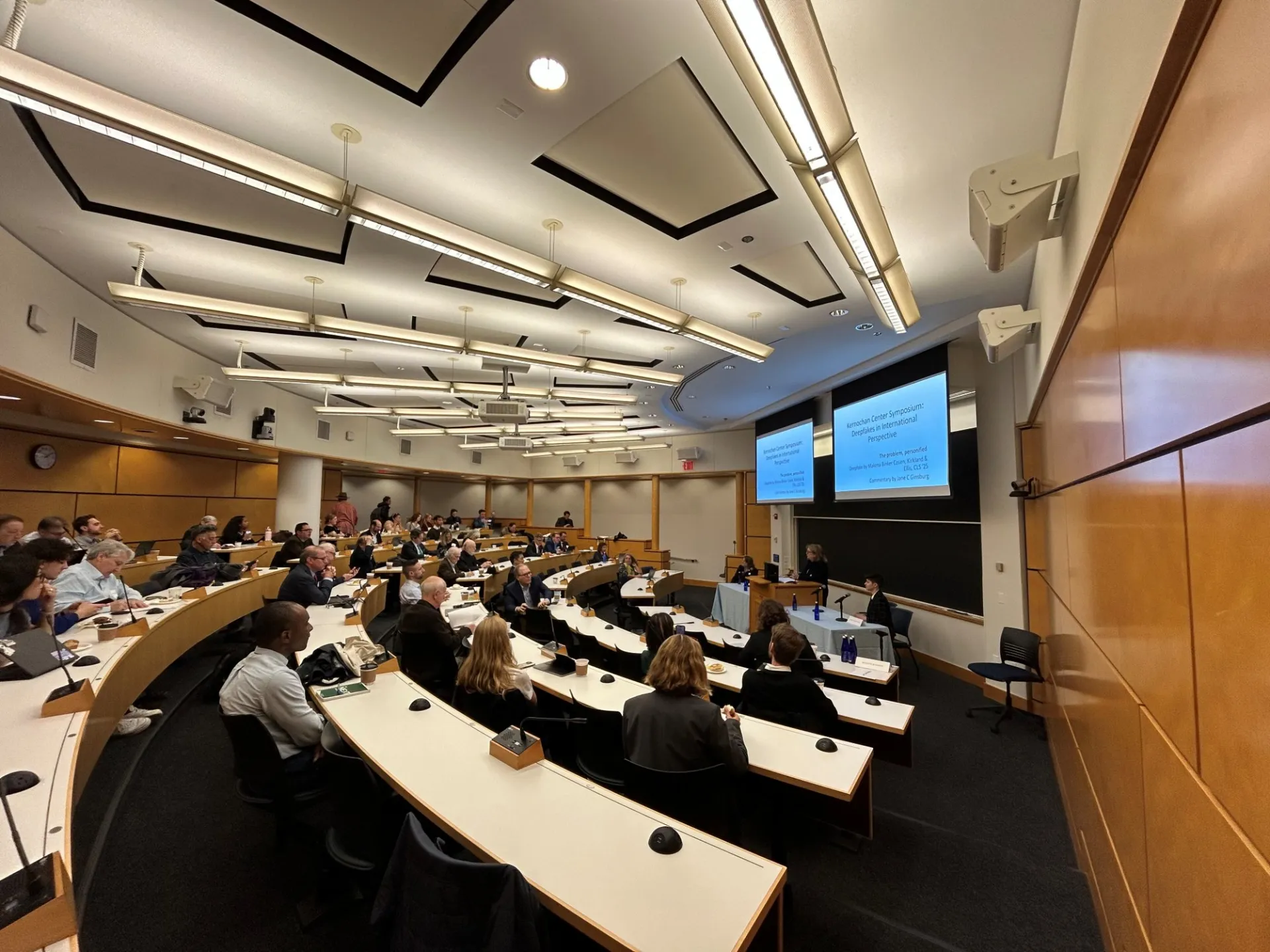
The 2025 Kernochan Center Symposium, in collaboration with the Columbia Law School and the Alliance Program
Law in the Age of Deepfakes: Scholars Debate Rights, Regulation, and Enforcement at Columbia Law School
As artificial intelligence continues to blur the boundaries between the real and the synthetic, the legal world is racing to catch up. That urgency was front and center at the Kernochan Center, where international experts gathered for a symposium, Deepfakes: In Search of Global Solutions
A New Frontier for Rights and Representation
The day opened with a live demonstration of AI-generated deepfakes by Makena Binker Cosen of Kirkland & Ellis—a striking display that included synthetic imagery and music created by machine learning models. Commenting on the demonstration, Professor Jane Ginsburg framed the issue succinctly: “If technology can convincingly recreate a human being, the law must decide what remains uniquely ours.”
A comparative panel followed, examining how different legal systems define and protect individual rights in the age of deepfakes.
- In the United States, Jennifer Rothman (University of Pennsylvania Law School) and Ben Sheffner (Motion Picture Association) discussed the evolving debate over the No FAKES Act, which aims to regulate digital replicas while balancing free speech protections.
- Representing the European Union, Valérie-Laure Benabou (University Paris-Saclay) analyzed new obligations established under the EU Artificial Intelligence Act (2024)—a landmark regulation that requires transparency and safeguards for AI-generated content.
- From the Commonwealth, Graeme Austin (Victoria University of Wellington, NZ) offered insight into how personality and moral rights are being adapted to address the unauthorized use of likenesses.
The morning closed with a discussion on public rights and transparency, led by Célia Zolynski (Paris 1 Panthéon-Sorbonne) and Olivier Sylvain (Fordham Law School; Columbia Knight Institute). They underscored the need for mandatory labeling and disclosure of AI-generated media—an essential first step in restoring trust in the digital public sphere.
From Principles to Practice: How to Enforce Rights Against Deepfakes
The afternoon session, “Enforcement,” explored how legal systems can turn rights into real-world remedies.
Professor Jane Ginsburg opened with a panel on jurisdiction and applicable law, where Edouard Treppoz (Paris 1 Panthéon-Sorbonne) outlined the cross-border complexity of enforcing deepfake regulations in a global internet. With content created in one country, hosted in another, and consumed everywhere, he noted, “enforcement cannot stop at national borders.” Graeme Dinwoodie (Chicago-Kent Law School) added that international cooperation—both legal and technological—will be essential to bridge these jurisdictional divides.
Next, Professor Shyam Balganesh (Columbia Law School) tackled the question of AI developers’ and platforms’ liability, exploring whether creators of generative models can be held responsible for their misuse. Drawing on recent cases such as Lehrman v. Lovo (S.D.N.Y. 2025), he outlined potential theories of derivative liability, including negligence and contributory infringement. Commentators Valérie-Laure Benabou, Edouard Treppoz, and Graeme Austin debated how to distinguish between open-source innovation and commercial exploitation—a line increasingly difficult to draw.
Finally, the civil enforcement panel, led by Philippa Loengard, featured David Louk (San Francisco City Attorney’s Office) discussing how local governments are responding to the harms of digital impersonation. Célia Zolynski and Edouard Treppoz compared U.S. and European approaches: while the U.S. often relies on tort and defamation law, the EU leans toward proactive regulation through transparency and labeling requirements enshrined in the GDPR and AI Act.
A Call for Global Cooperation
Across both sessions, a clear consensus emerged: deepfakes are not just a technological challenge but a legal and ethical one that transcends borders. Protecting individuals from digital manipulation will require an unprecedented level of coordination among legislators, courts, platforms, and AI developers.
As Professor Ginsburg noted in her closing remarks, the goal is not to resist technological change but to ensure that “human identity, dignity, and authorship remain protected in the digital era.”
The symposium reaffirmed Columbia Law School’s role as a global convener at the intersection of law, technology, and human rights, fostering dialogue that will shape the future of digital governance.