Call 2025 Joint Projects
Educating for Democracy: A Randomized Evaluation of Media Literacy and Civic Education Among Youth
The project will run a field experiment with high-school students in Brazil to measure the effects of free access to high-quality online newspapers on students’ news consumption, media literacy, and voting behavior. This intervention aims to increase their ability and interest in accessing high-quality information, at a time when news consumption and political knowledge among youth have been declining worldwide, making this group particularly disengaged from politics and vulnerable to misinformation. The intervention will randomly target high schools across a few Brazilian states (still under negotiation with local Education authorities). Students and teachers will receive one of the following interventions: (i) a free digital subscription to OGlobo, the leading Brazilian newspaper, (ii) media education modules delivered by teachers and developed by our partner NGO, Palavra Aberta Institute, or (iii) a combination of both. Through collaboration with OGlobo, we will access new usage data for treated students. We will also measure electoral turnout, taking advantage of the unique opportunity presented by the 2026 elections in Brazil, where youth can register to vote at age 16. This will be the first experimental evidence of this type from a developing-country context, where informational inequalities are wide and social media use is more prevalent.
The Impact of Art & Design on International Cooperation
Art and design are not merely sources of cultural expression; they are strategic instruments through which organizations and states communicate and seek to further their objectives. While international organizations such as UNeSco and the United Nations have long mobilized art and design to advance their mandates, academic engagement with this domain remains fragmented and lacks a comprehensive analytical framework. This project addresses that gap by establishing the foundation for a long-term, interdisciplinary initiative on the art and design of international cooperation, with a particular focus on how art and design objects support the mandates of UN system organizations. As part of a pilot phase, the project will produce a concept paper presenting the intellectual orientations of the field and a thematic exhibition examining two emblematic cases: the artworks of the UN headquarters in New York and the emblems of the United Nations system. This exhibition, entitled “Art and Design of International Cooperation,” will be presented in parallel with the conference “Communicating for a Better World: UN Communications at 80,” held in October 2026. Building toward a cycle of annual research projects and culminating in a permanent exhibition for the UN’s 85th anniversary, the initiative positions art and design as powerful tools for renewing public engagement with an ailing multilateral system by bringing the UN closer to the people.
The Post-Western Offshore System: Regulatory Fragmentation and the Rise of New Financial Secrecy Hubs
The 2016 Panama Papers leak exposed the global offshore system's role in facilitating tax evasion, illicit financial flows, and kleptocracy, sparking international political scandals and new transparency initiatives. Yet nearly a decade later, the post-Panama Papers era has produced neither a coherent international regulatory regime to manage offshore finance nor robust global norms to challenge its centrality in the global financial architecture. Instead, it has been characterized by growing regulatory divergence within the West—with Europe adopting incremental transparency reforms while the second Trump administration dismantles U.S. enforcement—and geographic shifts away from Western jurisdictions toward emerging offshore hubs in Dubai, Singapore, and Hong Kong. This Alliance project– proposed by researchers at Columbia’s Committee on Global Thought and Sciences Po’s CERI– will examine how the global offshore system is evolving amid this regulatory fragmentation and broader geopolitical reconfigurations. It addresses three core questions: How has the offshore system adapted since the Panama Papers? What roles do transnational professional enablers play in sustaining this evolving secrecy infrastructure across democratic and authoritarian contexts? What methods are needed to research these dynamics effectively? Understanding these dynamics is essential for grasping how contemporary globalization, governance, and inequality are being fundamentally reconfigured.
Ecological Resources, Belonging and Temporal Imaginaries in Guinea
This project proposes a workshop-conference to be held in Paris in May 2026 that examines how temporal imaginaries of the past and future and claims of belonging shape distributional conflicts over ecological resources in Guinea, with broader relevance for West Africa. The event shifts analytical focus from the material eIects of extraction to the narrative and temporal registers through which political actors define rightful beneficiaries, autochthony, and responsibility for environmental harms. Bringing together anthropologists, political scientists, architects and historians, the workshop explores how struggles over ecological resources like land, minerals, forests, and waterways are articulated through competing interpretations of history, settlement, and futurity under conditions of climate change, green capitalism and financialization. A central objective of this event is to rebalance scholarly exchange by foregrounding the work of Guinean researchers, who rarely have opportunities to present to European and North American audiences. Through closed panels, a public-facing discussion, and a planned journal special issue, the project aims to generate new comparative insights into the politics of time, resources, and belonging. We provide a platform to Guinean researchers whose voices are too rarely heard while fostering long-term research partnerships between institutions in Guinea, France, and the United States. The proposal addresses all the four priority areas of the call: Climate change and sustainable development; Race relations, inequality and social justice; Democracy and human rights; The Humanities.
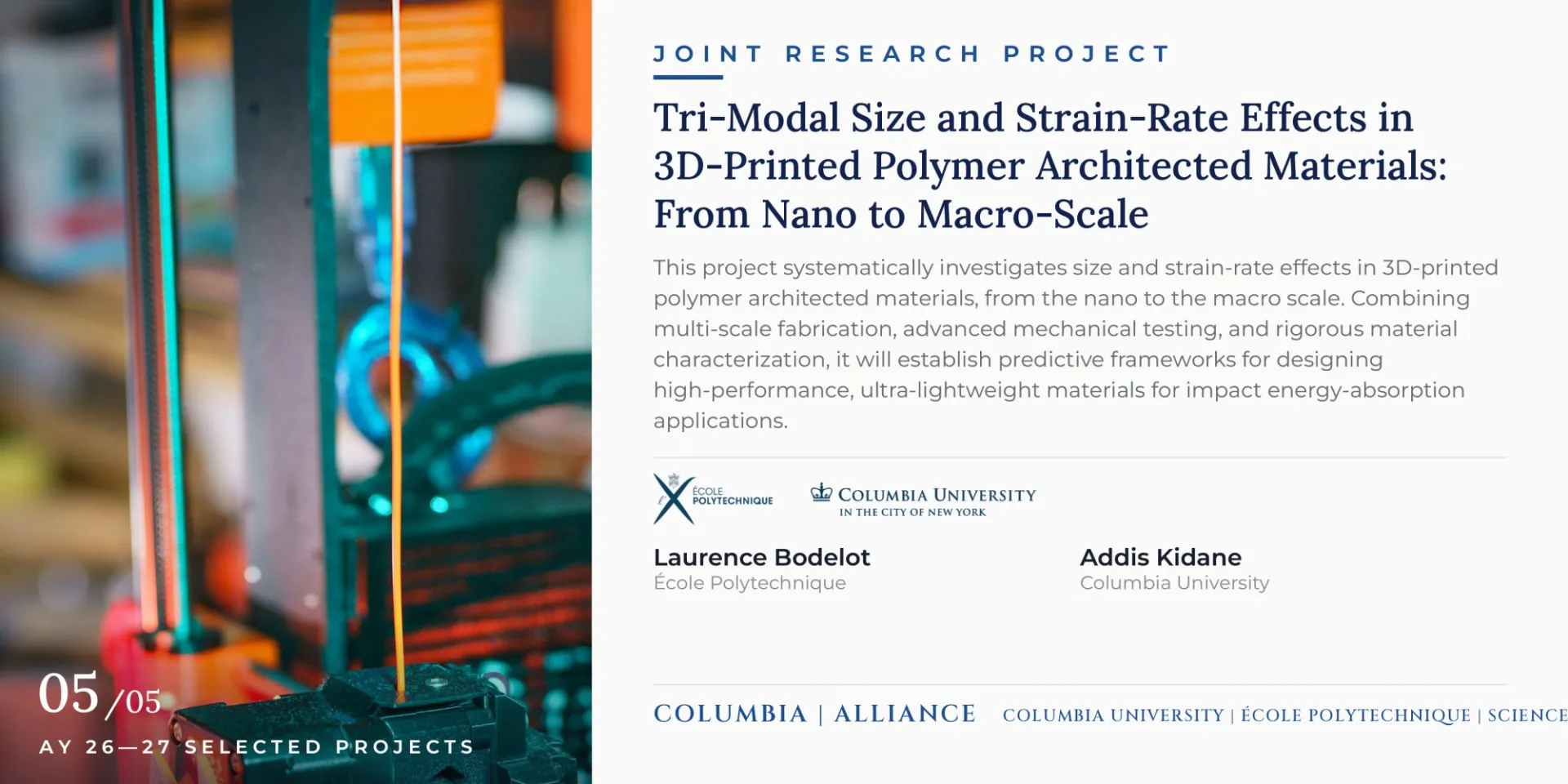
Tri-Modal Size and Strain-Rate Effects in 3D-Printed Polymer Architected Materials: From Nano to Macro-Scale
Recent advances in additive manufacturing have enabled precise fabrication of architected materials with controlled structures across multiple length scales. Cellular materials, in particular, offer ultra-lightweight, nearly isotropic mechanical properties, making them attractive for applications such as thermal insulation, vibration damping, acoustic control, shock mitigation, and energy-storage systems. While existing models provide useful design guidelines, they rely on continuum assumptions that neglect potential size-dependent and strain-rate effects inherent to additively-manufactured (AM) polymer materials. This research proposes a systematic investigation of the tri-modal size effect in AM cellular materials and its interaction with loading-rate sensitivity. Building upon the strong experimental mechanics expertise of Kidane and Bodelot, the project aims to determine whether deformation mechanisms and energy-absorption efficiency remain independent of overall structural and feature size, manufacturing process, and strain rate. The approach integrates multi-scale fabrication using one-photon and two-photon polymerization techniques, advanced mechanical testing, and rigorous characterization of parent photopolymer materials to ensure consistent bulk properties across processes. The outcomes will establish predictive multi-scale frameworks for the optimized design of high-performance architected materials for impact energy-absorption applications.