Sciences Po Law Review Hosts Transatlantic Symposium on Law & AI
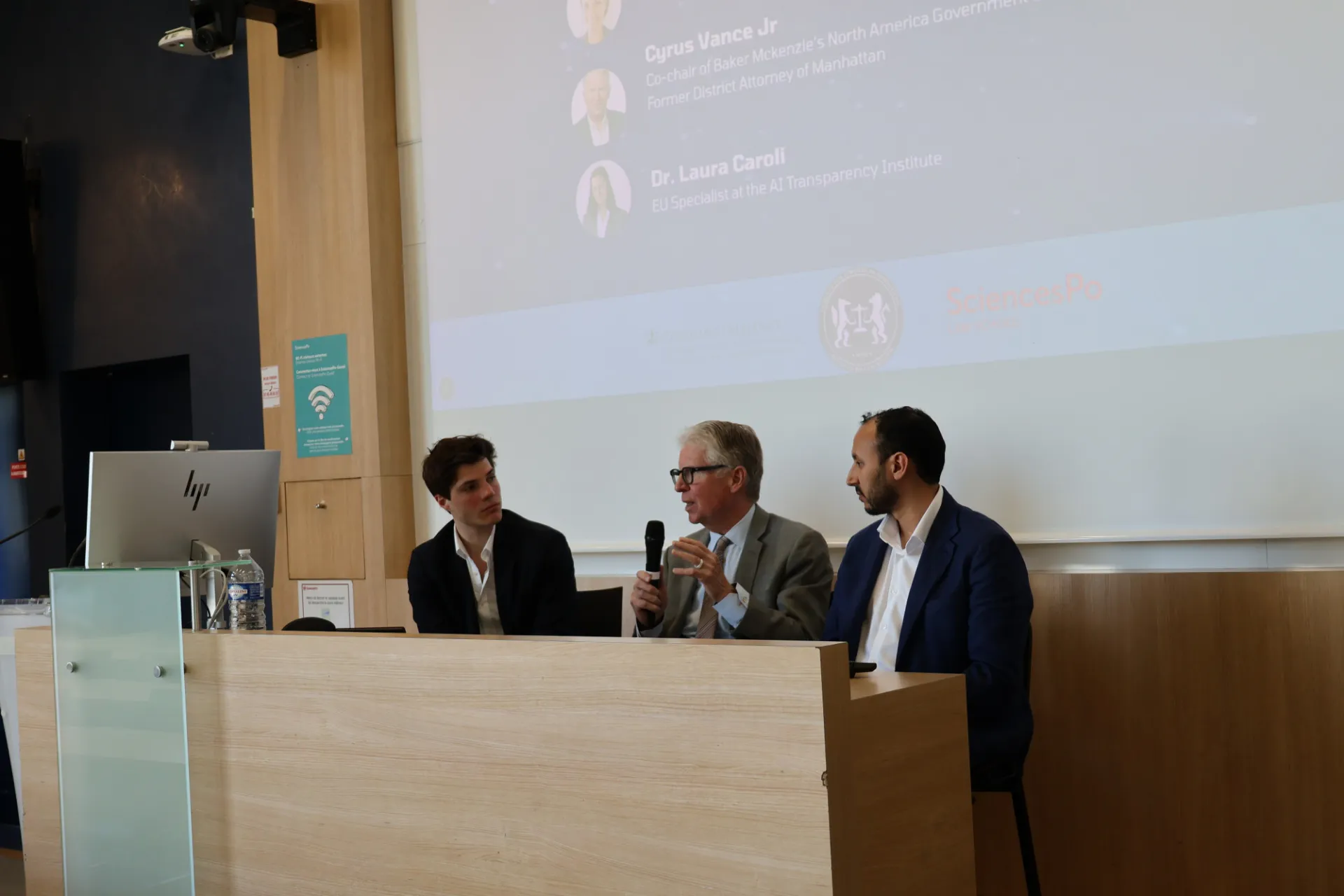
On April 24, 2026, la Revue des Juristes de Sciences Po (Sciences Po Law Review) hosted a full-day symposium bringing together legal scholars, technologists, policymakers, and practitioners from both sides of the Atlantic to explore how artificial intelligence is reshaping the legal landscape.
Made possible through partnerships with Sciences Po Law School and the Alliance Program of Columbia University, the event sought to foster a transatlantic intellectual exchange on the questions that matter most at the intersection of law and AI. The symposium gathered over twenty speakers representing institutions including Georgetown Law, the University of Toronto, the European University Institute, UNESCO, Baker McKenzie, and Google, among others.
The program unfolded across five thematic panels addressing the most pressing dimensions of the AI governance challenge. Discussions ranged from AI's role in public administration and democratic institutions, examined by Cyrus Vance Jr. and Dr. Kamel El Hilali, with introductions from Dr. Eva Thelisson and Dr. Laura Caroli, to the disruption AI poses for the legal profession itself, with industry leaders from Doctrine and Jus Mundi asking whether technology replaces or augments legal work. A parallel session tackled the urgent question of copyright in the age of generative AI, drawing together perspectives from La Sacem, Google, and the Sciences Po Law School faculty.
Later sessions turned to AI alignment, safety, and existential risk, and to the environmental stakes of AI expansion, where speakers asked what a genuinely green framework for AI governance might look like. The day concluded with a keynote roundtable on transatlantic AI governance, featuring Professors Anupam Chander, Nathalie Smuha, and Nicolas Petit, examining how Europe's regulatory ambitions intersect with American market dynamics and the geopolitical race for AI leadership.
The day's discussions ultimately converged on a shared conviction: that navigating the challenges of AI requires, above all, a return to first principles; which entails a deliberate choice about which values we want to place at the center of governance frameworks. Speakers across panels underscored that no single country can address these risks in isolation, and that meaningful progress depends on international cooperation and the establishment of a global level playing field.
It is precisely this kind of transatlantic dialogue that the Alliance Program seeks to foster. Our congratulations to the Sciences Po Law School for organizing the event, we are delighted to have been able to support it.