Europe Will Shape the 21st Century: French Minister for Europe and Foreign Affairs Visits Columbia
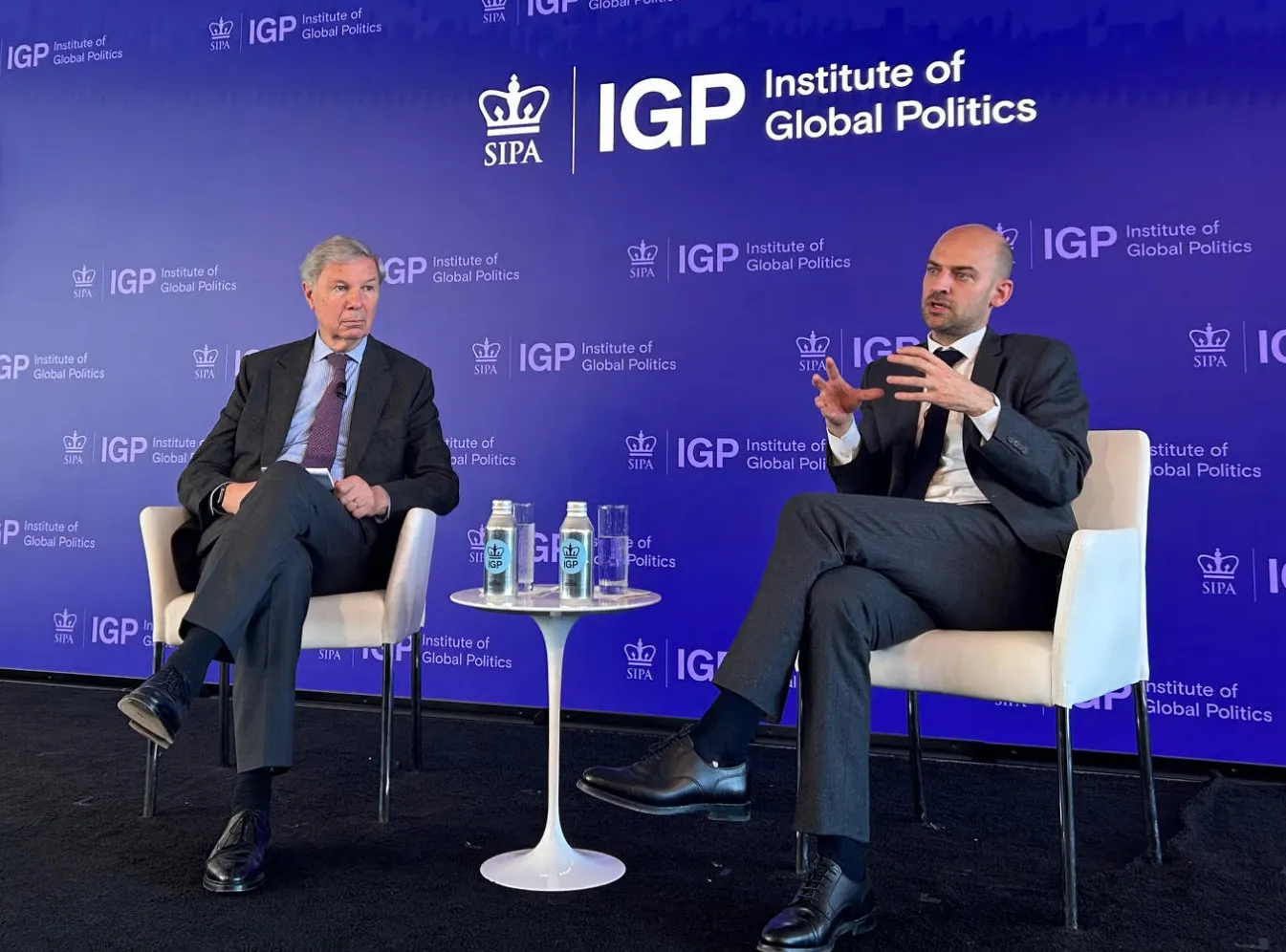
On April 27, 2026, French Minister for Europe and Foreign Affairs Jean-Noël Barrot visited Columbia University amidst diplomatic engagements at the United Nations for a timely conversation on major global challenges defining the current moment. From the war in Ukraine and tensions in the Strait of Hormuz to the future of the Nuclear Non-Proliferation Treaty and the shifting rules-based international order, Minister Jean-Noël Barrot discussed the future of international security and why Europe must stand at the forefront.
Minister Barrot reflected on his days as a summer visiting researcher at Columbia's Business School, thanking the sponsors of the event for the opportunity to return to campus.
He began by addressing overall challenges faced by the international community, explaining how rising tensions between the United States and China in the global arena prompt European leadership to reinforce both security and sovereignty for nations across the globe.
Minister Barrot emphasized the current European geopolitical predicament, facing the “dual pressure [of] Chinese competition and American tariffs.” He explained the necessity of “a third path, a demanding path, anchored in national sovereignty and respect for international law,” in light of growing U.S.-China tensions, positing that "in this geopolitical equation..., this unknown variable is Europe."
Minister Barrot cited the changing role of the United States within the rules-based order and its relative enforcement of international law, explaining that international trust has deteriorated as the "American hyper-power -- confident and unchallenged -- began to bend the very rules it had once defended." He also explained that "for much of the world, this was not a moment of emancipation. It felt like supervision. The memory of colonial domination had not disappeared, nor the resentment of structural adjustment programs, nor the scars of unilateral interventions. And frustration gave way to something sharper: a desire for revenge."
In this light, Minister Barrot explained how China's rapid infrastructure growth was inspired by its memory of the "Century of Humiliation" and the Opium Wars, and how China renegotiated its global power through current growth across the Belt and Road Initiative and BRICS.
He explained that this moment of geopolitical growth can reposition Europe as a leader. “This is where resistance to the brutalization of the world is indeed taking shape. Because from Southeast Asia to Latin America, across Africa, free people, that are willing to remain so, are watching Europe. Waiting for it to step up. Waiting for it to lead.”
Ultimately, Minister Barrot remarked that "Europe is now taking responsibility for its own security,” emphasizing the necessity of European leadership amidst global power struggle. Following his remarks, Minister Barrot engaged in a discussion with Jean-Marie Guéhenno, Columbia | SIPA, and answered questions from students, highlighting the importance of emerging generations in shaping diplomacy and navigating an increasingly complex world.
This event was hosted by the Institute of Global Politics at Columbia | SIPA, Co-sponsored by the Alliance Program, Columbia European Institute, and Arnold A. Saltzman Institute of War and Peace Studies.