Columbia x Alliance Française Funding Proposal
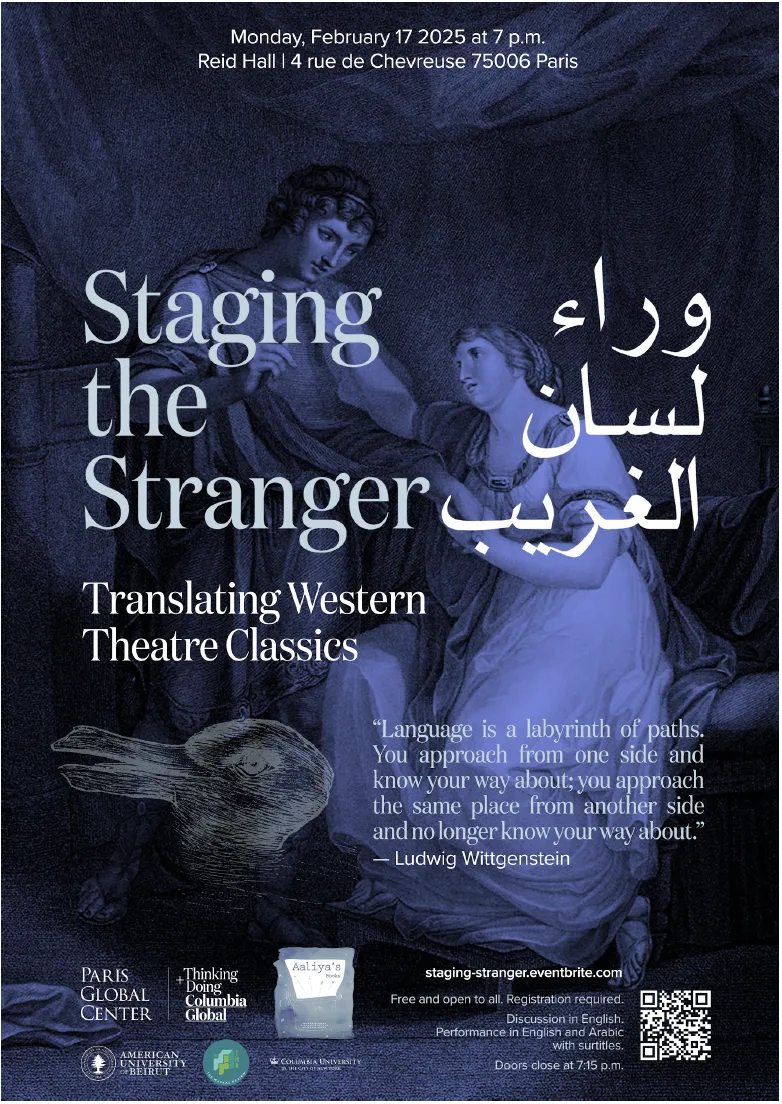
“Staging the Stranger: Shakespeare in Arabic”
Introduction
This application is a funding proposal for a student-led collaborative project between Mariam Tell (Columbia University School of General Studies ‘27) and Marie José Rizk (Sciences Po Paris ’25), in conjunction with Paris-based theatre director Georgina van Welie. The project we propose is a programmed event to highlight the shared efforts of theatre makers in adapting Western theatre texts to the Arabic language and context. In doing so, we also hope to proceed in our development of a bilingual theatre adaptation of Shakespeare’s Troilus and Cresida.
We are hoping that this collaborative project will help us find a permanent transatlantic home for this kind of programming and translation/adaptation work, which is why we are seeking a collaboration between Columbia University, Columbia Global Center in Paris, and Sciences Po.
Origins of the Project & Collaborations
Over the summer, Columbia student Mariam Tell was back at home in Beirut and watched the performances of two Lebanese theatre-makers’ recent adaptations: Caroline Hatem’s Transit Tripoli, based on the German novel Transit byAnna Seghers, and Lucien Bourjeilly’s An Enemy of the People, based on the play by Henrik Ibsen. At this time, she was working as Literary Events Coordinator at Aaliya’s Books, a bookshop and events venue in Beirut. While looking for literary material, she came across this article by Georgina van Welie, describing a similar trend of work with her Arabicadaptations of Shakespeare, for The Royal Shakespeare Company and other international arts venues.
The panel discussion that we currently have planned was initially supposed to take place at this time. The theme was“theatre in adaptation”, discussing both the literal adaptation/translation of texts into Arabic, but also the act of adapting theatre-making to the political and cultural demands of its production context. Caroline, Lucien and Georgina agreed to take part in this panel, which would be followed by a sample workshop of Georgina’s current adaptation-in-progress, an experimental bilingual adaptation of Shakespeare’s Troilus and Cressida.
It was at this time that partnerships with the American University of Beirut and The Markaz Review were initiated. Lucien Bou Rjeilly, a professor and director of the Theatre Initiative at American University of Beirut, offered to co-host a secondary workshop on adaptation and translation with the panelists at the AUB. Simultaneously, The Markaz Review (an online print review of art, music, film and more, with a focus on writers and artists from the Middle East and North Africa) had offered to help publicize the event in their monthly publication and social media platforms, as well as write an article about the event.
Everything was in order for this event to take place in the second week of September; however, it was sadly curtailed bythe developments on the Lebanese-Israeli border, which escalated into a full-blown military conflict in September, 2024. As two of our panelists remained in Lebanon and participated in community efforts to support the influx of refugees intoBeirut, Georgina and Mariam began to sort out an alternative arrangement for the event to move forward. In November, Georgina reached out to Reid Hall, the Columbia Global Center in Paris, who generously offered to host our event on February 17. The event would go on as planned, with a digital showcase of Lucien and Caroline’s previous work, a panel conversation, and a live performance showcase of Georgina’s work-in-progress with a sample of the digitalscenography, sound design, and newly translated bilingual text. However, the scope of this event has widened vastly: we are now presenting to French, American, and Arab audiences what was previously supposed to be a small-scale student-led event in a Beirut bookshop.
About the Student Leads
Project Leads Mariam and Marie are both students from Lebanon, and met in September 2024 when Marie was on her year abroad in Dublin, and Mariam was completing her last year of the Trinity College Dublin portion of her dual degree with Columbia. As the war commenced in Lebanon, Marie became interested in this event as a means for translating andadapting the act of theatre making to a new American/French audience: an effort which felt all the more pertinent amidst the conflict and devastation back home.
While this event remains true to its original intentions, it has changed substantially to grow to be an international collaboration with a team of dedicated thinkers and artists. Our collaborative endeavour represents nationalities from the US, France, Lebanon, the UK, Iraq, Syria, Jordan, and Canada. It is our hope that this event is a starting point to further enhance and grow this network of translators, adapters, designers, and students with a shared common interest in language as a means for inter-cultural communication. By basing ourselves in Reid Hall in Paris, we are hoping to find a transatlantic institutional home between Columbia University and Sciences Po, but also between the United States andEurope. We emphasize the importance of these two settings because we think that this is where Arabic, and as a result Arabic culture, has incited the most controversial reactions and receptions in recent years.
Our Aims
When this event was initially devised, the main focus was to highlight the use of language as more than just a communicator, but as part of the storytelling. Our panelists have adapted and translated texts by Camus, Brecht, Chekhov, Ibsen Shakespeare and more; these are texts that are hailed as achievements of the ‘Western canon’, but wesee this label as mistaken because it negates the texts’ true universality. Instead of offering a text from an Arabic-speaking culture to a European audience, we believe that we can discourage the audience from observing experiences on stage as those of the ‘Other’ when such experiences are instead adapted versions of what was written about by Western authors; this makes the experiences universal, not ‘Western’ or ‘Arab’, despite the fact that they are presented in Arabic. The fact that Georgina, Lucien, and Caroline — three theatre makers with very different backgrounds — all share this strategy is, we think, a testament to the importance of language and universal story in today’s globalized world. This is why we are trying to highlight this joint effort by hosting a panel discussion. Our first aim, then, is to display and illustrate adaptation and translation through Arabic as a means for intercultural communication within a common frame of reference.
Our second aim is to establish an ongoing partnership with the Parisian arts scene through this work. We have invited Sciences Po university faculty, as well as creatives from other theatre and arts organizations to attend our event. In doing so, we hope to find a permanent home for this kind of work, in part also so that we will be able to continue the full adaptation and translation of Troilus and Cressida for a public productionin France, and then the United States. Interestingly, Arabic theatre artists were also featured in Festival D’Automne in Paris this year, and it is also due to be a focus of the 2025 Avignon Festival. It is our hope that this event will fit into the ongoing interest of the French and American public in Arabic-speaking theatre and theatre that comes from the Arab world. It is common enough to attend talks, plays or performances in other European languages subtitled in French or English; it is not as common to see Arabic integrated into cultural programming. Thus, we would like to begin to introduce and habituate the theatre viewer living in major cities like Paris or New York to hearing and seeing Arabic as a language of arts programming.
Lastly, we see this event as only the starting point. With plans to bring this event and its workshop elements to Beirut over the summer, and then New York in the fall, we have also reached out for collaboration with programmers and producers in the United States and the United Kingdom, as well as other organizations across France. Columbia Global Center Paris has graciously said that they see this event as the beginning of an ongoing partnership, which is wonderful for allowing such a collaborative endeavour to receive the support and attention we feel it deserves. Furthermore, we plan to make a film of the showcase directed by French film maker Karim Goury to present to theatre programmers and theatre festivals throughout Europe and the States to commission a full production of Troilus and Cressida in its bilingual and subtitled format; this event will be a wonderful opportunity to attract co-producers.
Educational and Research Aims
As students, Marie and Mariam will be integrating this event into their own educational interests. Mariam’s Senior Thesis(a requirement of the TCD/Columbia dual degree program) is about the Pan-Arabization of arts-making in the Middle Eastern diaspora through multilingual performances by artists in urban centers. As such, this multi-national collaboration has been approved by her supervisor as a form of socio-linguistic ‘field work’, and the audience’s reaction to this Phase I panel and showcase will be the first step in her qualitative research. Proceeding from here, she would like to bring such a project to Columbia in the 2025-26 school year, which will provide a new perspective for how such an event is received in New York City compared to how it was previously received in France.
As a political humanities student at Sciences Po Paris, Marie's interest in this event and ongoing project stems from its cultural and sociopolitical significance. The project offers a unique opportunity to explore the intersection of art, language, and public space in a city that has long upheld systemic elitism, often marginalizing non-Western cultural expressions.This initiative challenges dominant cultural narratives and seeks to foster a more inclusive artistic landscapein Paris. At a time when Arabic is increasingly misrepresented and even at times vilified, this project offers its stage to the voices weaving stories of identity, resistance, and hope. Marie envisions this as an opportunity to break down barriers between artistic expression and sociopolitical discourse, transforming theatre into a dynamic dialogue on language, heritage, and belonging—ultimately creating a space where Arabic is embraced as an essential part of the Parisian and New Yorker theatre scenes.
About the Panelists
Lucien Bourjeily is an Emmy-nominated writer and director of both theater and film. He is a Fulbright scholar and holdsan MFA in Filmmaking from the Loyola Marymount University in Los Angeles. He is currently the interim co-director of the American University of Beirut’s Theater Initiative and is actively involved in AUB’s theater program as Artist in Residence.
He brought his progressive approach to theater to London’s LIFT Festival in 2012 with his hard-hitting immersive play 66 Minutes in Damascus, which was selected by the Huffington Post as one of the "10 plays in the world that rethink the stage." For his activism against censorship in the arts in Lebanon, he was nominated for the 2014 "Freedom of Expression" award by Index on Censorship in London. In 2014, he wrote and directed Vanishing State at the Battersea Arts Centre in London as part of the LIFT festival. The play involves the audience in drafting the Middle East’s borders alongside French and English diplomats (Sykes and Picot) at the end of World War I—a secret agreement whose consequences are still strongly felt throughout the Levant region today. Just months after the civil strife in Tripoli ended, in the spring of 2015, he wrote Love and War on the Rooftop. Directed by him, the play was performed by ex-fighters from the warring neighborhoods of Beb El Tebbeneh and Jabal Mohsen. His work in both theater and film has traveled the global festival circuit and earned him numerous awards, including the 2017 Dubai International Film Festival Jury Prize for his debut feature film Heaven Without People. Most recently, he adapted Ibsen’sAn Enemy of the People (2024), staging it as an immersive promenade experience in various locations within AUB’shistoric campus in Beirut.
Caroline Hatem is a theatre director, choreographer, and actress. She holds a Masters in Philosophy from Paris 8 and has specialized in dance and theatre in the United States (University of Arizona, Lee Strasberg), France (RIDC), and Lebanon. She is co-founder and president of YAZAN and has initiated the Network for Cultural Outreach, an EU-fundedproject aiming at decentralising performing arts in Lebanon.
Apart from a career as a dancer and an actor, she created her first choreographies and performances in dance with How They Thought a Table is a Table (2008), The Joy Series (2009), JoKaRi (2009), Solitude (2010), and Le Critère de Griffith (Beirut, 2015). Her latest choreographic work includes Together We Walk, an immersive installation combined with live performance, produced by Yaraqa for Dubai 2020. Her first theatre work, Al Beyt, by Arzé Khodr, has toured inLebanon and Tunis (Carthage Theatre Festival) and won Best Actress and Best Script at the first edition of the Lebanese National Theatre Festival (2018). Her second work, Al Zifaf, an adaptation of Brecht’s A Respectable Wedding, represented Germany at the European Theatre Festival in Beirut in 2019. She adapted and directed in 2022 The Just Assassins by Albert Camus (Les Justes), in Lebanese dialect, which toured in Lebanon, namely at the Bacchus Temple in Baalbeck in 2022. Her fourth work, TRANSIT TRIPOLI, a free adaptation of Anna Seghers’ novel Transit, premiered at the Akademie der Künste in Berlin, in partnership with the Schaubühne Theatre. It was performed at the superb Oscar Niemeyer’s Rachid Karame International Fair in Tripoli, and has since toured worldwide: Beirut, Cairo (D-Caf), Tunis (JTC), London (Shubbak Festival).
Georgina Van Welie, theatre producer, adaptor, and dramaturge, began her career at the Royal Shakespeare Company in the UK after graduating from Cambridge University. She directed three shows for their Fringe Festival before foundingher own company, Inigo Productions. From 2002 to 2013, she co-founded Sabab Theatre, producing bilingual Arabic/English theatre productions in collaboration with prestigious performing-arts organizations including: The Kennedy Center, BAM New York, Arts Emerson (USA); The Royal Shakespeare Company, Riverside Studios, Gate Theatre, Shubbak Festival (UK); Le Comédie Française, Bouffes du Nord (France), The Holland Festival, Warsaw Festival, Attiki Festival (Greece); The Tokyo International Arts Festival, Seoul Performing Arts Festival, Singapore Arts Festival, Sydney Festival; Dar al Athar Al Islamiyyah (Kuwait), Al Ain Festival, Sharjah Biennale, Cairo International Theatre Festival, and Le Tournesol Theatre (Beirut). She is currently working on a bilingual Arabic-English adaptation of Shakespeare’s Troilus and Cressida, as part of a new “Problem” Shakespeare Trilogy.
About the Showcase & Production Team
The showcase will be a 15-minute sample excerpt from the bilingual performance of Troilus and Cressida with animation by scenographer Bissane Charif. The digital scenography follows a conceptual take on bilingual writing, since text is socentral to Shakespeare; thus, the screen will be split into two sides, with Arabic and English text moving from either direction and enmeshing into one another.
Georgina van Welie, Director/Adapter (see above)
Ghareeb Iskander, Adapter/Translator: Ghareeb Iskander is a poet, translator and researcher living in London. Hetaught Arabic at SOAS, University of London, where he received his PhD in Near & Middle Eastern studies with an emphasis on literary translation. He published several books including A Chariot of Illusion (Exiled Writers Ink, London 2009); Gilgamesh’s Snake and Other Poems, a bilingual collection, which won Arkansas University’s Arabic Translation Award for 2015 (Syracuse University Press, New York 2016); English Poetry and Modern Arabic Verse: Translation and Modernity (I.B Tauris, London 2021). He was long listed for the 2021 John Dryden Translation Competition. He is a judge of the Sarah Maguire Prize for Poetry in Translation 2024. Iskander translated Derek Walcott, Ted Hughes and other world modernist poets into Arabic and Abdul Wahab al-Bayati, Hassan al-Shaikh Ja’far and other Arab modernist poets into English.
Bissane al Charif (Set Design and Animation) is a Syrian-Palestinian multidisciplinary artist based in Paris. She studied Architecture at the University of Damascus and Scenography at the Nantes School of Architecture in 2006. Throughout her career, she has worked as a set, video, and costume designer for numerous performances, including While I Was Waiting (Avignon, 2017), The Factory (Volksbühne Theater, 2018), Temporary People (NYU Abu Dhabi, 2022), Woman at Point Zero (Royal Opera House, 2023), and Yesterday’s Encounter (Freiburg Theater, 2024). Beyond her theaterwork, Bissane creates personal multimedia installations. Her acclaimed project Women’s Memory, which documents the stories of Syrian women refugees, earned her the Chevalier de l’Ordre des Arts et des Lettres in 2015. Her drawingproject Pianola was featured in the collective exhibition Dislocations at (the Palais de Tokyo in Paris, 2024).Dressing Room, (2024) marks her directorial debut in theater.
Timeline
Early September, 2024: Initial planned date for Theatre in Adaptation panel at Aaliya’s Books in Beirut, Lebanon; postponed due to conflict and travel restrictions.
Late September, 2024: Ghareeb Iskander joins the production team for the Troilus and Cressida adaptation
October-December 2024: Georgina and Mariam move forward with planning for an eventual postponed version of the event
November 2024: Reid Hall (Columbia Global Center Paris) agrees to host our event on February 17. Partnership with The Markaz Review (publicity, post-event reception, live streaming, article written on their website) and Aaliya’s Books(supplier of a Lebanese wine and book pairing to the post-event reception) is finalized.
December 2024: Applications for funding go out to the Anna Lindh Foundation and AUB for travel support to bring Caroline Hatem and Lucien Bourjeilly to Paris
December 2024: Marie Jose Rizk becomes an Associate Producer on this event and the adapted showcase/productionof Troilus and Cressida. Marketing efforts begin with Columbia Global Center Paris’ in-house communications team, led by Charlotte Force.
January 2024: Application for funding to Columbia Alliance and Columbia University’s Middle East Institute; MEI offers a mobility grant of $1200.
February 2025: Event takes place on February 17, followed by a wine and book curated sale organized by Aaliya’s Books and the Markaz Review for the post-event reception.
March - May 2025: Efforts will be made to consolidate partnerships and further opportunities for programming and co-production with festivals or organisations in the US, UK and France.
June - September 2025: Reiteration of this event in Beirut, Lebanon and potentially other cities across the Arab World.
September - December 2024: Mariam will be in New York at this point, and Marie will be back in Paris. We hope that this trans-Atlantic partnership that was established between them through this event will turn into a joint programming endeavour. Our main goals will be to continue development of Troilus and Cressida through a larger, transatlanticnetwork of theatre makers/adapters/translators who we can invite to speak in NYC and Paris as a sort of bi-continental, multilingual, complimentary performing arts program.
Student Project Leads
Mariam Tell — Producer
Marie José Rizk — Associate Producer
Professional Project Leads & Collaborators
Georgina van Welie — Director
Niamh Fleming Farrell — Aaliya’s Books (Organizer)
Jordan Elgrably — The Markaz Review (Partner)
Organisations
Columbia Global Center Paris
- Brunhilde Biebuyck — Reid Hall and Paris Global Center Director
- James Allen — Senior Special Projects Coordinator
- Marie Volga Doezema — Senior Special Projects Manager
- Charlotte Force — Communications Coordinator
Aaliya’s Books (Beirut, Lebanon)
- Niamh Fleming Farrell — Owner of Aaliya’s Books, famous bookshop and wine bar in Beirut, Lebanon
Partnerships
The Markaz Review
- Jordan Elgrably: Editor in Chief and Art Director
- Sarah Naili: Public Relations and Production Manager
American University of Beirut Theatre Initiative
- Lucien Bou Rjeilly (see below)
Panelists
- Georgina Van Welie: Co-founder of SABAB theatre and director of upcoming showcase; theatre producer, writer and dramaturge
- Caroline Hatem: President and co-founder of YAZAN Beirut, director of three plays adapted from their French/English formats into Arabic
- Lucien Bourjeilly: Artist in Residence and Director of the Theatre Initiative at American University of Beirut.
Showcase Production Team
- Bissane Al Charif, Khatt Foundation: Set Designer & Digital Scenographer
- Ghareeb Iskander, Literature Across Frontiers: Translator/Adapter
- Frederick Waxman: Sound Designer